________________________________________________________________________
During the development of S0M_Ai, I have reviewed three tensions in dance improvisation as research and creation practice.
________________________________________________________________________
1) The conflict between reflecting on dance and reflecting through dancing implicated in the structure of somatic dance.
I release the tensions by restructuring the practice, where the warm-up (visualisation exercises), the creative practice (dance improvisations), and the dance reflection (storytelling) become simultaneous activities in the practice. S0M_Ai instructs and questions the dancer through different audio messages. It is a controllable generative software system that ‘thinks’ along with the dancer and stimulates embodied dance awareness and reflection through expanding embodied cognition.
________________________________________________________________________
2) The methods for reflecting on dance adds onto the embodied experience through storytelling, relying on short-term and biographical memories or fantasies.
After the last review of this project, I have studied the work done by Bessel van der Kolk, The Body Keeps The Score to tackle the question of linking the memories with the experiences of the dancer. The main subject of his work is the study of different types of memories and the central role of the body when accessing or refuting lived experiences. This resonated with work done by phenomenologist Prof. Claire Petitmengin, whose first-person experiential philosophy inspired what is known as the ‘explicitation method; a speech protocol regarding the remembrance of first-person experiences. I depart from the assumption that if we understand the world through a limited series of experiential metaphors (Lakoff and Johnson), we may peak under the veil of dance cognition by analysing the storytelling.
________________________________________________________________________
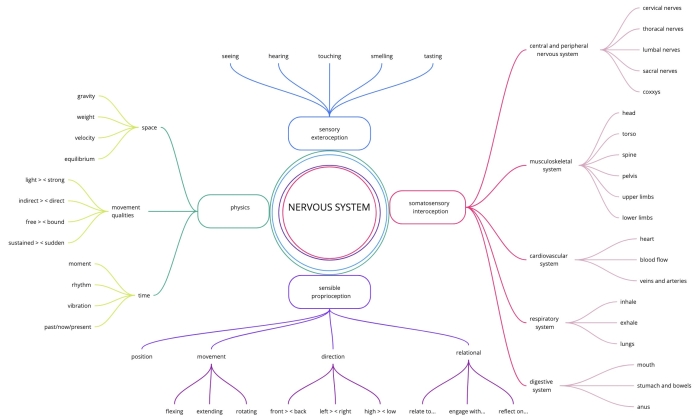
S0M_Ai is a user-friend database of over 2000 somatic metaphors transcribed from participative research. The transcriptions were modulated according to a somatic speech protocol (1st person singular present tense, no names, all statements are turned into questions and visa vers). This results in two databases with numbered metaphors: even numbers are statements, uneven are questions. Eventualy, the database is checked for reoccuring keyterms (80 in total). These keyterms are coded and maped out in a metastructure that is inspired by somatic dance studies and theories by Irmgard Bartennief Fundamentals, Rudolf von Laban Methodology, Bonnie Bainbridge Cohen Body-Mind Centering, and Moshe Feldenkreis Method. At last, all the expressions are re-recorded in audio-files and organised in correspondence to their key-term libraries. The libraries are then connected to an interactive interface using MAXmsp and Indesign software and results in the beta version of S0M_Ai.
________________________________________________________________________
3) The tension between the conventions and principles of somatic dance and the limited dance style and movement dynamics it produces.
The interface of S0M_Ai allows the user to choose between a random generated exercise (score) or a more specific mode in the dance improvisation. In the second option, one can select different key terms from the menu referring to what one wants to visualise and exercise during the improvisation (f.ex. a score for breathing, focusing on fast movement in the lower limbs). Additionally, we have developed other options such as controlling the balance between statements and questions, timing the exercise and controlling the speed of speech, or selecting the quality of voice. When the dancer presses the central play button a virtual host, whose design is based on previous research on LifeForms/Danceforms aesthetics, gradually produces the auditive visualisation exercise and generates a score according to the selections.
________________________________________________________________________